
Table of Contents
Sardegna is where happening Italians go in summer, which means I spent most of my time feeling like I'd snuck into a party I wasn't invited to. Think the Hamptons, but with better food.
I wasn't there on billionaire money—not even close—but I'd found a flight deal and a small apartment rental in a town that wasn't one of the famous ones. The goal was simple: beach, food, and whatever else presented itself. After months of intensity in Barcelona, finishing up my semester abroad with exams and goodbye parties and the stress of transition, I needed somewhere warm and slow and beautiful without demands. Sardegna delivered in ways I hadn't anticipated.

The beaches are what everyone talks about, and they deserve the reputation. The water is a color that seems artificial—turquoise graduating to deep blue, so clear you can see the bottom in twenty feet of water. The sand is white in some places, pink in others (the famous pink beaches of Budelli, where centuries of crushed coral have tinted everything salmon). I spent mornings on beaches I'd have to myself for hours, floating in water warm enough to stay in indefinitely, watching the occasional sailboat pass on the horizon. The Mediterranean has been swum in for millennia, and floating there I felt connected to that long history of people seeking pleasure in the same blue water.
But it was the land that surprised me. The interior of Sardegna is nothing like the coast—it's ancient and mysterious, dotted with nuraghi, those Bronze Age stone towers that are unique to the island. Nobody knows exactly what they were for: fortresses, temples, chieftains' residences, some combination of all three. There are thousands of them scattered across the island, ruins of a civilization that left no written records. They're everywhere once you start looking, rising from hillsides and fields, silent remnants of people who built with stone to last millennia.
Walking through one, climbing the narrow internal stairs to emerge on the rooftop with a view of the surrounding countryside, I felt the weight of deep time in a way that's rare for someone used to American history's relative shallowness. These structures were old when Rome was young. They'd stood while empires rose and fell around them. They'd watched as the island was conquered and reconquered, as languages and cultures washed over it like waves. And still they stood, weathered but intact, monuments to whoever built them for whatever purpose they served.

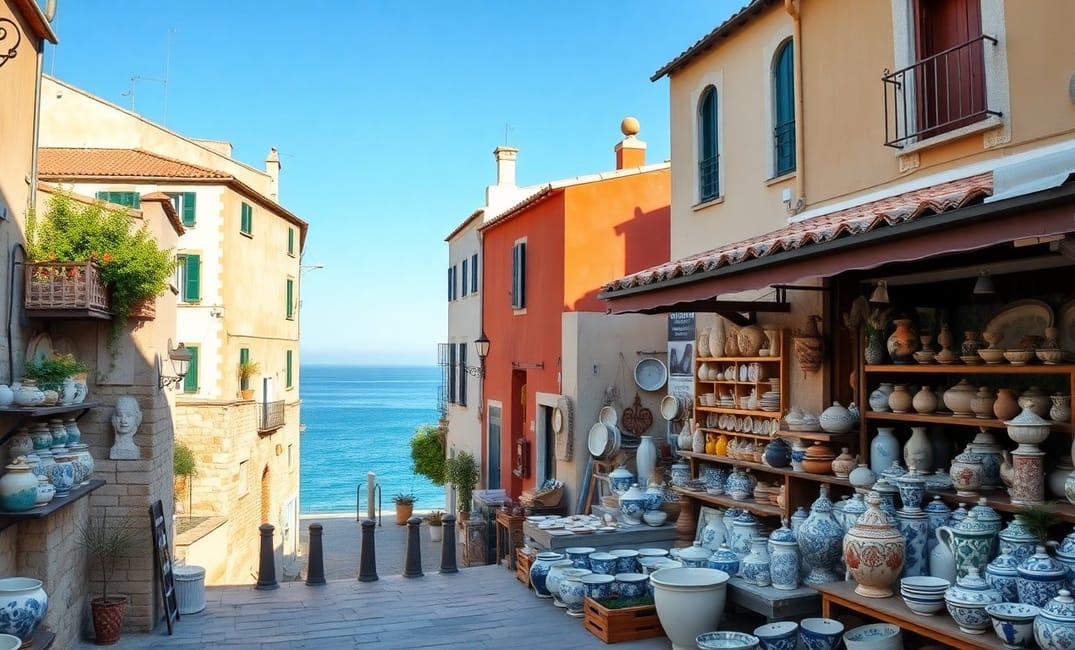
Sardinian craft has its own traditions, distinct from mainland Italy. The ceramics here tend toward earthier palettes—browns and greens and muted reds, colors that come from the island itself. The famous corked ceramics of Oristano, with their stoppers carved from local oak. The painted majolica of Assemini, brighter and more decorative. The rough terracotta of rural villages, functional pieces made for kitchens rather than galleries. I went looking for something that felt specifically Sardinian, something I couldn't have found anywhere else.
Without Luca and Martina I would have stumbled into every trap the island sets for well-meaning visitors with more money than local knowledge.
The town I was staying in had a Saturday market, the kind of village event where farmers sell vegetables and cheese, old women offer home-baked goods, and a few craftspeople set up tables with their work. I'd been going each Saturday morning, mostly for the food—the cheese here is extraordinary, pecorino aged in caves, creamy and sharp simultaneously—but on my last Saturday I wandered further into the market and found a man selling pottery.
He was Sardinian in that unmistakable way: dark-featured, compact, speaking Italian with an accent I could barely understand even with my basic Spanish helping. His pottery was simple, functional, the kind of stuff you'd actually use rather than display. But one piece stood out: a cup with a distinctive shape, wider at the top than the bottom, glazed in colors that reminded me of the landscape I'd been driving through—deep blue like the sea, touches of brown like the sun-baked hills.

He told me about the cup through a combination of Italian, gestures, and my increasingly desperate attempts at communication. It was a traditional shape, he said, something his grandfather had made and his father after him. The glaze was mixed from local materials—clay from the hills, minerals from the coast, recipes passed down without being written. He didn't make many of these anymore; most customers wanted easier things, cheaper things, things they wouldn't have to explain to people back home. But he liked making them, liked the connection to his family's history, liked knowing that somewhere in the world his cups were being used by strangers who'd bothered to notice them.
I bought the cup for almost nothing—a few euros, the kind of price that made me want to pay more but know he'd refuse if I tried. He wrapped it in newspaper with hands that were calloused and careful, the hands of someone who'd been working with clay for decades. When he handed it to me, he said something I didn't fully understand but took to be a blessing or a farewell or both.
The cup has become my morning coffee cup. It's not perfect for the purpose—slightly too wide, the handle a bit awkward—but I use it anyway because holding it reminds me of that market, that conversation, that last Saturday in a place I probably won't return to. The glaze has developed a patina from years of use, the colors deepening where the coffee stains it, the surface growing smoother from my hands. It's become part of my routine in a way that none of my other pottery has, an object that I interact with daily rather than simply admire on a shelf.
I'll go back to Italy. I always go back. And each time I'll probably buy another piece of pottery, adding to the collection.

Sardegna feels like a secret, even though it's not. The beaches are well-known, the Costa Smeralda is famous for its wealth, the whole island is on every "best of Italy" list you can find. But the interior, the markets, the old men selling pottery their grandfathers taught them to make—that's a different island, one that tourists pass through without really seeing. I was lucky to catch a glimpse of it, to bring home something that carries that older Sardegna with it.
The Hamptons comparison still doesn't fit. The Hamptons are about display, about being seen in the right places. Sardegna, at least the part I found, is about the opposite—about a culture that's endured despite centuries of invaders, about traditions maintained because they matter rather than because they're profitable, about a pace of life that doesn't speed up for visitors. The cup on my shelf is a piece of that resistance, a small defiance of the modern world's rush. Every morning when I fill it with coffee, I'm participating in something old, something that connects me to an island I barely knew and a man whose name I never learned. That's the kind of connection objects can carry, if you let them.
The last afternoon in Sardegna, I drove along the coast, stopping at beaches whenever the road allowed access. Each one was slightly different—different color sand, different rock formations, different quality of light. But they all shared that impossible water, that Mediterranean blue that photographs never quite capture. I swam at three or four beaches that day, not staying long at any of them, just touching the water and moving on. It felt like a farewell tour, a way of saying goodbye to a place I'd barely gotten to know.
The ferry back to the mainland left at sunset. I stood on the deck watching Sardegna recede, the mountains turning purple against the orange sky, the lights of the coastal towns beginning to flicker on. The cup in my bag felt heavier than it was, weighted with all the meaning I'd assigned to it. That's what we do with objects—we make them carry more than their physical mass, we ask them to hold experiences they were never designed to contain. The Sardinian cup has held up under that weight. It still does, every morning, when I fill it with coffee and remember the island I left behind.